Massachusetts Population Estimates by County

On March 26th, 2026, the U.S. Census Bureau released its Vintage 2025 population estimates for July 1, 2024 through July 1, 2025 for Massachusetts and U.S. counties, which includes total population and population change by county, as well as the components of population change.
Select the drop-down menus below and see the downloadable reports at the bottom of this page for more information on these data releases.
According to the new county-level population estimates released by the U.S. Census Bureau, the greatest numerical increases in Massachusetts counties from July 1, 2024 to July 1, 2025 were seen in Middlesex County at 6,050 net persons gained; Worcester at 4,780; and Bristol at 2,775. In terms of percentage change, the largest net gains were in Worcester County and Bristol County, both with 0.5% increases from 2024 to 2025 (Table 1). These modest population increases are attributed primarily to a positive natural increase and total migration figure in Worcester County, and positive international and domestic migration in Bristol County.
The slowest growing counties in the 2024-2025 period by population count include Suffolk, with an estimated 1,644-person net loss; Berkshire, with an 825-person net loss; and Hampshire, with an estimated loss of 614 persons. The largest percentage decreases were in Berkshire (-0.6%), Dukes (-0.6%) and Hampshire Counties (-0.4%). Population loss in these areas during the 2024-2025 period can be attributed to a number of factors, including more deaths than births and a reversion to pre-pandemic migration trends in the seasonal counties of Massachusetts. During the COVID-19 pandemic, many people moved to seasonal homes in the Berkshires and Cape and Islands. Domestic migration into these areas remained robust in 2021 but estimates for the years 2022 through 2025 show a reversal of that trend in Berkshire, Barnstable, Dukes, and Nantucket counties, with domestic migration returning to pre-pandemic levels.

The U.S. Census Bureau develops county-level estimates using the latest data available for the various components of change, which include births and deaths, domestic migration (within the United States), international migration, and the group quarters population for each county. During the period of July 1, 2024 to July 1, 2025, half of Massachusetts’ 14 counties had a positive net natural increase, with the number of births greater than the number of deaths. These counties include, in order of the largest natural increase: Middlesex (+4,048), Suffolk (+3,594), Essex (+1,553), Worcester (+1,443), Norfolk (+896), Plymouth (+303), and Nantucket (+72).
The migration figures in the components of change show the majority of Massachusetts counties—10 out of 14—have negative domestic migration, meaning populations have moved from these counties to other counties within the U.S. In 4 of these 10 counties, however, the negative domestic migration is offset by international immigration. Counties with positive net domestic migration include Barnstable, Bristol, Franklin, and Plymouth, and while their immigration levels are more modest, these counties also show positive net immigration. Combining immigration with domestic migration, in the V2025 series, 8 of Massachusetts’ 14 counties show positive total net migration. A rebound in immigration in Massachusetts since the pandemic years and the Census Bureau’s multiple methodology revisions both factor into immigration levels in Massachusetts counties in 2025.

For more information about the Vintage 2025 county-level population estimates, download the full UMDI report and prepared workbook below or visit the U.S. Census Bureau’s Population and Housing Unit Estimates website.
Estimates for Massachusetts follow the national trend, showing a population that is growing older and more racially and ethnically diverse. Even though Massachusetts is less diverse than the U.S. average—with a combined racial and ethnic minority population of just 32.4% compared to 42.5% in the U.S.—the state’s population has been increasing in diversity at a faster rate than the national average. From 2010 to 2024, the racial and ethnic minority population in Massachusetts increased by 9.3 percentage points—from 23.1% to 32.4%—compared to a 6.4 percentage point increase in the U.S. overall. All Massachusetts counties have experienced increasing diversity since 2010 by varying degrees around the state.
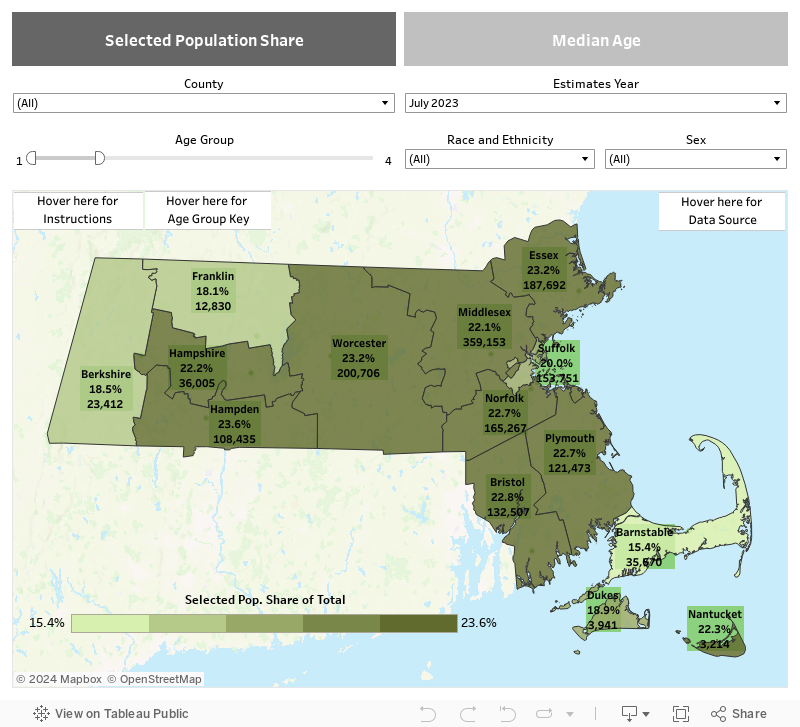
The Massachusetts counties with the greatest percentage of combined ethnic and racial minorities populations in 2024 were Suffolk (55.8%), Hampden (41.2%), and Essex (35.2%). The counties with the lowest percentage were Franklin (11.7%), Barnstable (12.1%), and Berkshire (14.6%).
Massachusetts has an estimated median age of 40.1 years in 2024. As of 2024, 10 out of 14 Massachusetts counties—over two-thirds—have a median age 40 or over. The counties with the highest median age are Barnstable (56.3 years), Dukes (50.8 years), and Berkshire (47.5 years), while the counties with the youngest median ages are Suffolk (34.2 years), Hampshire (37.0 years), and Middlesex (39.0 years). At the other end of the age-spectrum, counties with the highest percentage of children under 18 years of age include Essex (20.6%), Hampden (20.5%), Plymouth (20.2%), and Worcester (20.2%).
For more details on selected Massachusetts characteristics data and trends, please refer to the Summary of U.S. Census Bureau’s 2024 County Characteristics Estimates for Massachusetts Counties and the related Appendix in the Resources and Downloads section below. You may also view the complete datasets by visiting the U.S. Census Bureau’s Estimates page.